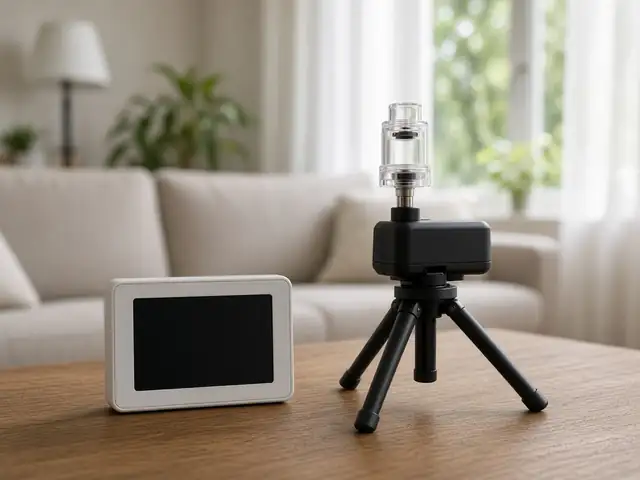
What an indoor air quality test checks
| Test | Why it matters |
|---|---|
| Mold spores (air samples) | Compares indoor spore counts and types with an outdoor sample to find hidden growth |
| Relative humidity and temperature | Above 60% humidity, mold and dust mites thrive; EPA suggests 30% to 50% |
| Carbon dioxide (CO2) | A sign of how well the home is ventilated |
| Particles (PM2.5) | Fine dust and smoke that reach deep into the lungs |
| Total VOCs and formaldehyde | Gases from new flooring, furniture, paints and cleaning products |
| Carbon monoxide | From fuel-burning appliances; dangerous at high levels |
| Radon | A radioactive soil gas; EPA's action level is 4 pCi/L |
When an air quality test is worth it
- A musty or stale smell you cannot trace. See musty smell in the house.
- Allergy or asthma symptoms that get better when you are away from home.
- After a leak, flood or water damage, to check whether mold spread.
- After renovation, new flooring or new furniture.
- Before buying a home, or before moving a baby or someone with a weak immune system in.
- After mold remediation, as a clearance check.
What causes poor indoor air
EPA lists the main sources as fuel-burning appliances, tobacco smoke, building materials and furnishings, household products, HVAC and humidifiers, excess moisture, and outdoor sources such as radon. Poor ventilation lets pollutants build up, and high temperature and humidity can raise some concentrations. In Charlottesville homes, excess moisture is the most common thread: USDA soil data flags a shallow water table on about 5% of Charlottesville city and 8% of Albemarle County, and damp basements and crawl spaces raise humidity and feed mold.
How the test works
- A short interview about symptoms, smells, water history and recent changes.
- A walkthrough with meters for humidity, CO2, particles and VOCs.
- Air samples for mold spores indoors and one outdoors for comparison.
- Optional tests: formaldehyde, radon, surface samples.
- A written report with results, likely sources and next steps.
Mold air testing vs full indoor air quality testing
A mold air test focuses on spores. A full indoor air quality visit adds meters and gases, which helps when the cause is not obvious. If you already know there is water damage, a mold inspection is usually the right starting point. If the concern is a general smell or symptoms, a broader air quality test can rule things in or out. See mold inspection and local testing prices.
Radon
Radon has no smell and comes from the ground. EPA recommends fixing a home at 4 pCi/L or more. A short-term test is inexpensive and can be added to an air quality visit, and it is especially worth doing if you have sealed a crawl space or finished a basement.
Choosing an air quality tester
Virginia does not license mold inspectors or indoor air quality consultants, so ask what certification the tester holds, which lab analyzes the samples, what exactly is included in the price, and for a sample report. Ask whether the company also sells remediation or air purification equipment; if it does, consider a testing-only company for an independent answer.
What an air quality test cannot tell you
A single visit is a snapshot. Humidity, CO2 and VOC levels change with the weather, the season and what is happening in the house that day. Mold spore counts vary from hour to hour, and EPA notes there are no federal limits for indoor mold, so results are compared with an outdoor sample rather than a pass/fail number. A good report explains what the results suggest and what to fix, not just a table of numbers. If symptoms are the concern, talk with a doctor as well; a home test does not diagnose a health condition.
Simple ways to improve indoor air
- Keep humidity below 60%; run bathroom and kitchen exhaust fans.
- Fix leaks and dry wet materials within 24 to 48 hours.
- Change HVAC filters on schedule.
- Ventilate during and after painting or cleaning.
- Service fuel-burning appliances and install CO alarms.
Frequently asked questions
What does an indoor air quality test check for?
It depends on the package. Common items are mold spores, relative humidity and temperature, carbon dioxide (a ventilation indicator), carbon monoxide, particles (PM2.5), total VOCs and formaldehyde, and radon. Ask exactly which tests are included.
Is a home air quality test worth it?
It is most useful when there is a specific concern: a musty smell, symptoms that improve when you leave the house, recent water damage or renovation, a new baby or someone with asthma, or a home purchase.
Can I test my own indoor air?
Consumer monitors can track humidity, CO2, particles and VOCs over time, and a short-term radon kit from a hardware store is inexpensive. Mold air sampling and lab analysis are best done by a professional, because results are only meaningful when compared with an outdoor sample taken the same way.
What humidity level should my house be?
EPA recommends keeping indoor relative humidity below 60%, ideally between 30% and 50%.
What radon level is too high?
EPA recommends fixing your home if radon is 4 picocuries per liter (pCi/L) or more, and considering a fix between 2 and 4 pCi/L.
How long do air quality results take?
On-site readings like humidity, CO2 and particles are immediate. Mold spore samples go to a lab, usually with results in a few business days. Radon tests run for at least 2 days.
How it works
- Tell us what is going onMusty smell, visible growth, a past leak or a home purchase. Choose testing, removal or both.
- A local mold specialist contacts youUsually within one business day, to schedule testing or a removal estimate.
- Get results and a written quoteRemoval is quoted by a certified remediation company. You decide whether to go ahead.
Schedule mold testing in Charlottesville
Testing, removal or both. A local specialist will contact you, usually within one business day. Free quote, no obligation.
Sources
- EPA, Introduction to indoor air quality: https://www.epa.gov/indoor-air-quality-iaq/introduction-indoor-air-quality
- EPA, A Brief Guide to Mold, Moisture and Your Home: https://www.epa.gov/mold/brief-guide-mold-moisture-and-your-home
- EPA, Mold testing or sampling: https://www.epa.gov/mold/mold-testing-or-sampling
- EPA, A Citizen's Guide to Radon: https://www.epa.gov/radon/citizens-guide-radon
- EPA map of radon zones: https://www.epa.gov/radon/epa-map-radon-zones
- Mold Inspection & Testing Charlottesville, pricing: https://moldinspectionandtest.com/charlottesville-va