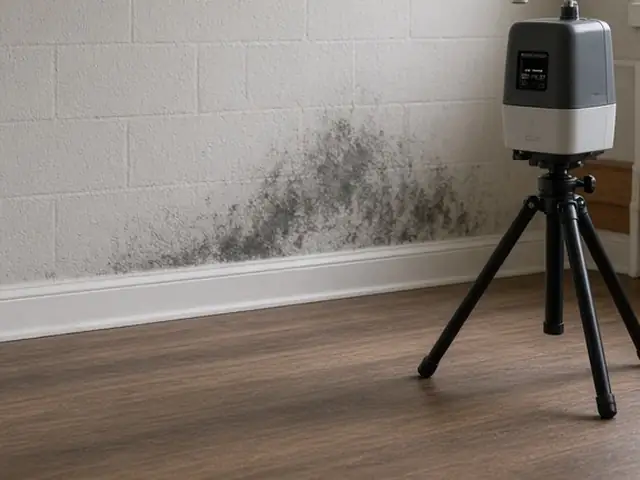
Stachybotrys chartarum vs other dark molds
Stachybotrys chartarum is a greenish-black mold that needs chronically wet cellulose: drywall paper, cardboard, dust and some wood products that stay damp for days or weeks. It is one of several molds that can produce mycotoxins under the right conditions. It is not the only dark mold, and it is not present every time someone sees black staining.
More often in Central Virginia homes, dark spots turn out to be:
- Cladosporium - very common indoors and outdoors; often olive to black on painted wood, drywall or HVAC surfaces.
- Aspergillus or Penicillium - frequent in damp drywall, carpet and crawl spaces; some species look dark gray or black in dense growth.
- Alternaria - often outdoor, but can colonize damp window sills and drywall.
Because color overlaps, a photo of black mold is not enough for a remediation scope. Lab speciation from air cassettes, tape lifts or swabs tells you whether indoor counts and types differ from the outdoor control sample taken the same day. EPA notes there are no federal numeric limits for indoor mold spores; the indoor-to-outdoor comparison is what matters.
Why visual ID is not enough
- Different species need different moisture histories and cleanup approaches.
- Dead mold and settled spores can still irritate some people after growth is cleaned.
- Selling or buying a home on a visual guess creates weak documentation for negotiations or landlord notices.
- Virginia remediators working under professional standards (EPA/HUD/IICRC-type guides) scope work from moisture mapping and, when needed, sampling - not from color alone.
If you already see a large area of growth, EPA guidance is that sampling is often unnecessary before cleanup of clearly moldy materials - but many Charlottesville homeowners still want species ID for peace of mind, for a buyer/seller dispute, or before opening walls. A local specialist can explain when samples add value.
Common black-mold spots in Charlottesville-area homes
The median Charlottesville home was built in 1967, and 64% were built before 1980. USDA soil data flags a shallow water table on about 5% of Charlottesville city and 8% of Albemarle County. Those conditions push moisture into:
- Wet drywall and baseboards after roof, plumbing or window leaks.
- Crawl space joists and sill plates over damp soil or a torn vapor barrier - one of the most common hidden sources in older Piedmont homes.
- Basement block walls at the floor-wall joint after heavy rain or poor grading.
- HVAC closets, drip pans and supply boots when condensate drains clog or ducts sweat in humid summers.
- Bathroom ceilings and shower surrounds without a working, correctly vented exhaust fan.
Blue Ridge freeze-thaw cycles and hydrostatic pressure against basement walls make seasonal seepage a regular pattern from Charlottesville through the Shenandoah Valley towns of Waynesboro and Staunton. If dark growth returns after bleach cleaning, the moisture source was never fixed.
How testing works
- Visual inspection and moisture meter or thermal readings to map damp materials.
- Indoor air samples compared with an outdoor control.
- Surface or bulk samples from the dark growth when species ID is needed.
- A written report with lab results, photos and next steps.
A basic Charlottesville mold inspection with two air samples (one indoor, one outdoor for comparison) is listed at about $300, with extra samples about $75 each, per a published local price list. See the full mold testing cost page and mold inspection guide.
Containment and HEPA remediation
Certified remediation for more than a small patch typically follows a professional sequence:
- Stop the water: plumbing, roof, grading, gutters or HVAC condensate.
- Isolate the work area with plastic containment and negative air.
- Remove unsalvageable porous materials (wet drywall, insulation, carpet) under controlled conditions.
- Clean and HEPA-vacuum remaining surfaces; run HEPA air scrubbers.
- Dry the structure to target moisture levels before closing walls.
- Optional clearance testing to document that indoor spore levels have returned toward outdoor baseline.
National cost ranges from HomeGuide put most jobs at $1,500 to $6,000, with small areas $500 to $1,500 and whole basements or attics often $6,000 to $15,000. Crawl space work is commonly $1,500 to $4,000 when growth is limited to joists and the soil can be dried and lined. Local quotes vary with access, square footage and whether encapsulation is added - see mold remediation and crawl space mold.
In Virginia, companies that sell residential mold remediation must hold a recognized mold remediation certification under 59.1-200. Ask to see it. Details: Virginia mold laws.
When to request a local quote
- Dark growth larger than about 10 square feet, or any growth in the HVAC system.
- A musty smell with staining on crawl space wood or basement walls.
- A home purchase inspection period with unexplained dark patches.
- A landlord or tenant dispute that needs lab documentation.
Request testing, removal or both below. Removal requests go only to certified remediation companies. You decide whether to hire anyone.
Frequently asked questions
Is black mold always Stachybotrys chartarum?
No. Many common molds look dark or black, including Cladosporium and some Aspergillus species. Stachybotrys chartarum is one toxigenic species that grows on chronically wet cellulose (drywall paper, dust, wood). Only laboratory analysis of air or surface samples can identify the genus and species.
Can I tell black mold by looking at it?
Visual ID alone cannot confirm species. Color, texture and smell are clues, not a diagnosis. A moisture meter reading plus air or tape/swab samples sent to a lab is how local specialists confirm what is growing.
Where does black mold usually grow in Central Virginia homes?
Chronically wet drywall, crawl space joists and sill plates, basement block walls at the floor joint, HVAC closets and drip pans, and bathroom ceilings without working exhaust. Humid summers and older vented crawl spaces make these spots common around Charlottesville.
How much does black mold testing cost locally?
A basic Charlottesville mold inspection with two air samples (one indoor, one outdoor for comparison) is listed at about $300, with extra samples about $75 each, per a published local price list.
How much does black mold removal cost?
HomeGuide national data puts most mold remediation at $1,500 to $6,000 ($15 to $30 per sq ft). Small patches can run $500 to $1,500; a whole basement or attic $6,000 to $15,000. Cost depends on how much material must be removed under containment.
Should I bleach black mold myself?
EPA says areas under about 10 square feet can often be cleaned by a homeowner after the moisture source is fixed, using detergent and water on hard surfaces - not as a substitute for fixing leaks. Larger areas, HVAC contamination or sewage-related water call for a certified remediator with containment and HEPA filtration.
Does Virginia require a certified remediator for black mold?
For residential mold remediation sold as a service, yes: Va. Code 59.1-200 requires a nationally or internationally recognized mold remediation certification. See Virginia mold laws.
How it works
- Tell us what is going onMusty smell, visible growth, a past leak or a home purchase. Choose testing, removal or both.
- A local mold specialist contacts youUsually within one business day, to schedule testing or a removal estimate.
- Get results and a written quoteRemoval is quoted by a certified remediation company. You decide whether to go ahead.
Schedule mold testing in Charlottesville
Testing, removal or both. A local specialist will contact you, usually within one business day. Free quote, no obligation.
Sources
- Mold Inspection & Testing Charlottesville, pricing: https://moldinspectionandtest.com/charlottesville-va
- Level Home Inspections, mold sampling: https://www.levelinspect.com/air-quality-mold-sampling/
- HomeGuide, mold removal and remediation cost (Feb 2026, national): https://homeguide.com/costs/mold-removal-cost
- EPA, A Brief Guide to Mold, Moisture and Your Home: https://www.epa.gov/mold/brief-guide-mold-moisture-and-your-home
- EPA, Mold testing or sampling: https://www.epa.gov/mold/mold-testing-or-sampling
- CDC, Stachybotrys chartarum and other molds: https://www.cdc.gov/mold-health/about/index.html
- Code of Virginia § 59.1-200 (Virginia Consumer Protection Act): https://law.lis.virginia.gov/vacode/title59.1/chapter17/section59.1-200/
- HB2195 (2025), mold remediator certification: https://www.vpap.org/bills/85702/HB2195/
- USDA soil survey summary, Charlottesville city: https://foundationsoils.com/va/charlottesville-city/
- Charlottesville housing, median year built (ACS via City Stats): https://city-stats.com/virginia/counties/charlottesville-city/housing/